


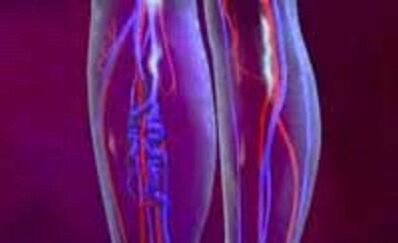
With varicose veins, veins of various organs (esophagus, seed cord - varicocele, rectum - hemorrhoids) can be affected, however, varicose veins of the legs are most often found.
What is it?
Varicose veins, or varicose veins (from lat.Varix- node, bloating) - persistent and irreversible expansion and lengthening of veins (blood vessels that carry blood to the heart) of the lower extremities with the thinning of the venous wall and the formation of “nodes” as a result of the rough pathology of the venous walls, as well as the insufficiency of their valves due to the genetic defect.
Since ancient times, doctors such as Hippocrates, Avicenna, Galen and Paracelsus tried to treat varicose veins, but unsuccessfully.For many years, the famous Italian anatomist and the doctor Marcello Malpigi, who had opened more 300 years ago, had devoted many years to the study of the disease.
Varicose veins are a fairly common disease.Nowadays, every third woman and every tenth man suffer from varicose veins, and most often the disease begins at a working age of 30-40 years.The more time a modern person spends in a sitting position at a computer or in a car, the higher the risk of varicose veins.Today, this problem is very relevant.
Why does it happen?
Varicose veins are not only the lower extremities, there is also varicose veins of the gastric veins and esophagus, the veins of the small pelvis, the veins of the testicle and the seed cord - varicocele.Varicose veins of the small pelvis are one of the causes of hemorrhoids, and varicocele threatens possible infertility, and surgery is required to prevent this.However, the most often varicose veins of the lower extremities are found.
The main causes of the development of varicose veins of the lower extremities are:
- Heredity - people in whose pedigree are frequent cases of varicose veins, are at risk;
- Paul: in women, a varicose disease provoke pregnancy and taking hormonal drugs;
- Increasing venous pressure (sedentary lifestyle, static loads in an upright position, obesity).
These causes of varicose veins contribute not only to the expansion of veins, an increase in venous pressure or violation of the normal operation of the venous valves.The consequence of the disease is the wrong, pathological flows in the veins of the lower extremities - refluxes (pathological, reverse venous blood flow from deep veins to surface).They also cause aggravation of the disease over time, as they increase pressure on the venous system many times.Therefore, the features of hemodynamics in varicose veins are both a consequence of the disease and its cause.A vicious circle occurs.
The correct blood flow is when blood flows through the veins of the legs from the bottom up, that is, against the action of the force of earthly attraction.This is achieved using several mechanisms: blood pressure from arteries (the most insignificant contribution), reduction of the leg muscles during movements (this acts as a pump) and the presence of valves in the veins that prevent the abode of the blood.It is the inability of these valves to fulfill its function and causes a violation of venous blood flow, which leads to overstretching of veins.As a result, the blood flow becomes chaotic, the blood stagnates in the veins of the lower extremities, especially in the subcutaneous ones, the pressure in them increases so much that the walls of the vessel are not withstanding and begin to expand and refine.
In people who have been on their feet for a long time (doctors, sellers, hairdressers), the risk of developing varicose veins is very large.
In women, the causes of varicose veins can be associated with a violation of the hormonal background (for example, incorrectly selected hormonal contraception).In addition, the varicose veins of the pelvic veins, as well as varicose veins of the lower extremities, often develops during pregnancy, when the pressure of the growing uterus into the veins of the abdominal cavity gradually increases, which, in turn, complicates the outflow of blood through the veins of the legs.
In addition, an increase in intra -abdominal pressure when lifting weights, coughing, sneezing, chronic constipation and so on also leads to a violation of the work of venous valves.
And finally, violations of the normal work of veins are quite natural for the elderly.
What is happening?
The first symptoms of varicose veins are the swelling of the legs by the end of the day, the feeling of severity and bursting in caviar, which appears during a long stay in a sitting or standing position.A characteristic of varicose veins is the disappearance or significant decrease in these symptoms when walking and after night rest.
Later, bursting pain in the calves, a sense of heat in the legs and nightly cramps in the calf muscles appear.In addition, small blue-red vascular “stars” appear on the legs, dark blue intradermal veins become visible, and finally the subcutaneous veins are expanding, which become similar to the clusters of overgrown red grapes.
If you start varicose veins, it is possible to develop eczema in the affected areas.
Diagnostics
So, if you notice the initial symptoms of varicose veins, in the near future, contact a phlebologist - a specialist in vein diseases.
The success of the treatment of varicose veins directly depends on what stage of its development the treatment has begun.The sooner you contact a phlebologist, the easier the treatment will be and the risk of complications will decrease.
After the initial examination, the doctor will prescribe this or that type of instrumental research.As a rule, ultrasonic dopplerography is enough to make a diagnosis.However, if there is a need, radionuclide and X -ray contact methods are also used - special substances are introduced into the bloodstream and examine their distribution through the vessels.
Treatment of varicose veins
How is varicose veins is treated!?Three methods can be treated with varicose veins: surgical surgery on varicose veins, the use of sclerotherapy or medication.In addition, during the treatment of varicose veins, physiotherapy exercises and therapeutic knitwear are actively used.
The essence of sclerotherapy is the introduction of special drugs into the veins that cause gluing the walls of the vessel and the closure of its lumen.
With surgical treatment of varicose veins, the affected veins are simply removed.It is important to note that the removal of subcutaneous veins does not interfere with blood flow and is safe for the body.Through surface veins, which affects varicose veins, only 10 percent of the blood flows normally.The rest of the load takes on the deep veins of the legs.And therefore, after the operation of removing varicose veins in most cases, these vessels are easily compensated for by the function of surface veins.
Remember: varicose disease can and should be treated, because in the absence of treatment it is fraught with unpleasant complications.